

Probably one of the most stressful times in a student’s life is going to be when they are considering what they are going to do after they graduate. Who can really blame them? People begin asking what their plans are, and when you are seventeen or eighteen years old, no one wants to make a life altering decision. But there are things that you and your student can do to help minimize the level of stress by having a strategic plan for making decisions.
As a former admissions counelor and director of admissions, I’ve met with many, many students who aren’t sure about what it is that they want to do, where to go to school, or if the school that they are currently visiting is even the right one for them. Then there are the parents! You guys have your own set of questions and expectations. Getting you both answers and helping you think through the process can make a world of difference.
Today, I want to focus on getting both parents and students to think about important questions, to encourage discussion between you, and to give you a basic timeline that can help you stay on track. I’m also going to give you a few helpful things to ask while you are visiting colleges. And please note: not every student is going to go to college. There is absolutely nothing wrong with that. But every student should pursue some kind of education or training that will help them be able to have an income. This can be through college or university (be that a four year or two year institution), trade school, or even the military. I’ve worked with plenty of students who settled on trade school and the military after going through some of the information I’ll be sharing with you today.
Questions Your Student Should Ask Themselves
Not that I want to add any more to the plate of a student who is preparing to go into their senioryear of high school, but that’s the way it goes sometimes. There are many things to consider when you are in the beginning stages of looking for a college. I would recommend spending the second semester your junior finding the answers to these questions, but if not, the summer before your senior year….you really need to have these mostly figured out.
- What do I want to do? Its a huge question, but one that you need to have a general answer to. I don’t think you need to have it narrowed down, but having a general idea can quickly narrow down the types of schools you’ll be looking at and programs. I’m not saying that you need to know that you are going to work in an extremely niche field, but knowing that you are interested in business can help make sure that you are meeting with the business professors at prospective colleges.
- What do you want your college experience to be? Obviously, you want to learn a skill that is going to allow you to be competitive in the job market. What I’m talking about isn’t necessarily the education part, but the having new experiences part. Do you want to live on campus and be a part of clubs? Are you hoping to be a college athlete? Are you wanting to have a large friend group? Do you want to be a part of a fraternity or a sorority? Do you want to be aware from your parents, but close to other relatives? Is it important to you to have study abroad opportunities? What do you want to experience/ Thee are all things for you to be considering, because college is the time to have these experiences before you have the responsibilities that come with having a job, families, houses/apartments, and other obligations.
- What are your values? This might come as a surprise, but not all colleges are created equal. We all have things that are important to us, and things we want to be exposed to to help us grown as people. I can’t tell you want your values are, but I strongly encourage you to consider the things that are important that you have in your daily life.
- Where do you want to go geographically? People have preferences, and realistically some people will do better in some environments over others. But knowing how far you want to go away to college will help you narrow down where you are going to be looking. Also, part of this is knowing if you want to be on a larger or smaller college campus. If you decide you want to be in Kansas, within three hours of Kansas City, and at a smaller school, you won’t be going to Kansas State. Using this to narrow the search will help you quickly figure our what schools you need to zero in on and strongly consider.
- What are you willing to pay? This is a reality that I have found many students don’t actually consider until they are looking at their bill after they have signed up for classes. Education is a business, and it is a business that provides a service. You have to pay for that service. You need to have a very realistic plan of how you are going to be paying for college. That can be working, scholarships, athletics, campus jobs, savings, loans, parents – but you need to know before falling in love with a school if you can pay it.
Questions Parents Should Be Asking Themselves
Students are the only ones who have a lot on their minds as graduation draws near. Parent s also need to be thinking about a few things as well.
- What does your student want? Yes, you are there to guide and encourage them, but don’t put your hopes and dreams on your kids. They may not want to be in sorority like you were. That’s okay. Let them make some of their own decisions. You can place guiderails up, and you do have a say – but don’t try to relive or live vicariously through your student.
- Determine how much you can help them. What does this mean to you as a parent? Have you and the other parent discussed this? And most importantly, does you student know what the expectation is.
- What are your requirements for their choice of school? Like I said, you need to be guiding them, but that doens’t mean they go off and do whatever. If you are assisting with paying for it, I think it is fair to say that you have certain expectations as far as grades go, and what type of school they go to.
- Are you being a realist when it comes to your student’s abilities? I hate to say it, but most parents – in my experience – overestimate what their student is capable of academically and athletically. Not that there is no talent, but you need to be realistic. If your student has a 13 ACT and a 1.98 CGPA they have no business going to a four year institution; they need to go to community college, and they probably shouldn’t be full-time.
- Have you had these discussions with your student? That should be a given, but the number of times I have had families in my office on enrollment day being told that their parents aren’t going to be able to make payments, or have a coach sell a student on a school and they are all excited only for me to have to tell them that they are denied admissions – no matter how good their parents think they are.
A General Timeline
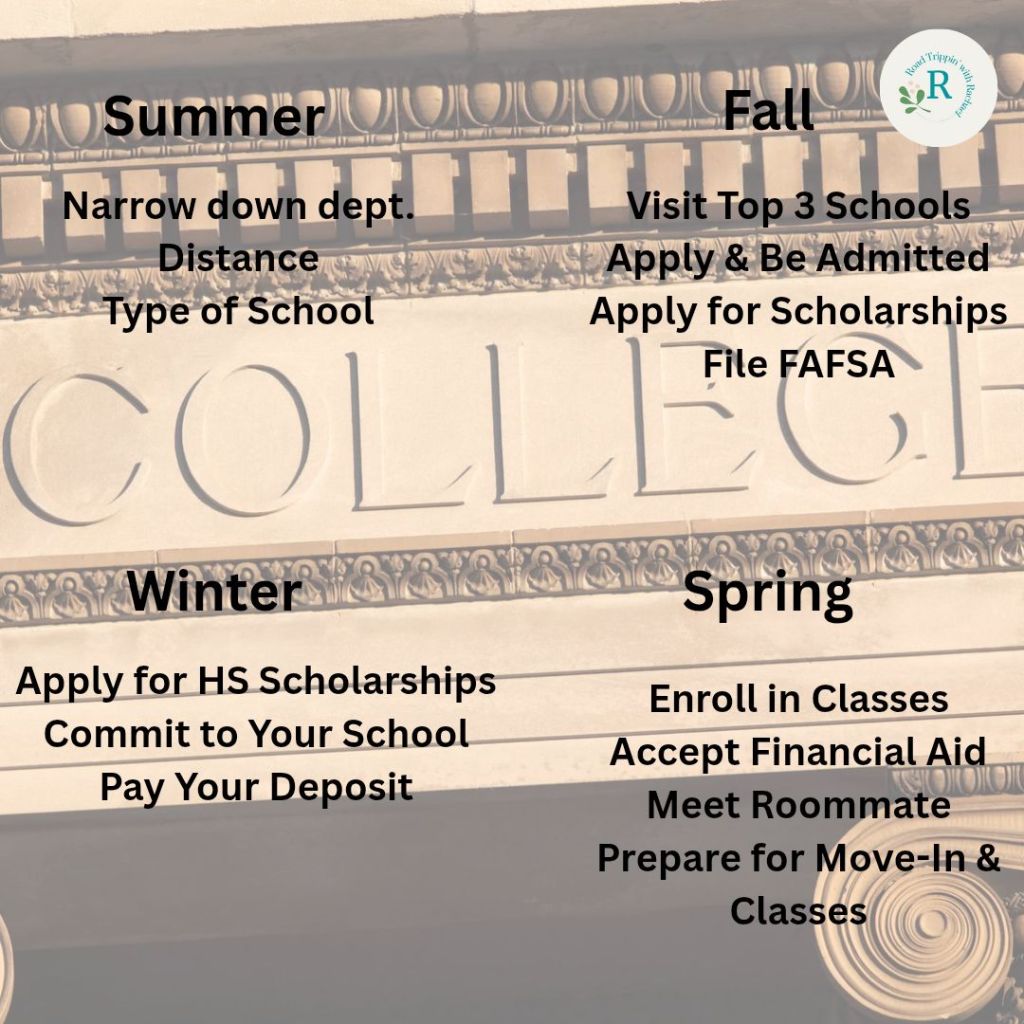
This is the outline that I would recommend using to look at colleges.
Spring/Summer (Junior/Senior Year) – you need to have answers to the questions above, and you need to have had some heart to hearts with your students. Students, you need to be requesting information from the colleges you are interested in.
Fall – If you can get it narrow down over the summer to three – five schools, you should go visit them, and apply to the top three. Get all your documents in to be admitted, sign up for the ACT if needed for the fall and get the paperwork done. Remember that FAFSA normally opens in October each year. The sooner you get that filled out the faster you will get your financial aid packages from the colleges you are considering.
Winter – you need to be applying for scholarships if you haven’t already – specifically the local ones. You also need to commit to the school that you have decided to go to, and sign your letter of intent. Tell the other schools that you aren’t going to attend.
Spring – Enroll in classes, set up your payment plans, and find out who your roommate will be if you are living on campus. This is the fun part of the year, where you make some really good memories.
Other Tips From a Former Admissions Director
- Have an email dedicated to the college search. Have information from colleges and any scholarship information sent there.
- Tell the admissions counselor if you’ve decided to go somewhere else. Believe it or not, you won’t hurt their feelings; if anything you’ll make their life easier by not having to contact you anymore.
- What to do when you have an IEP. An IEP (Individualized Education Program) is a legal document while your student is in school – not college. Whether you like it or not, you student is an adult according to the Department of Education once they have been enrolled in classes at a college or university (legally), which means that parents cannot be the initiator for any services. All services have to be student initiated.
- Ask about the policy for Service Animals if you have one. Aske the Student Life Department what their policy is, but keep in mind that if you have the correct documentation, ADA trumps everything.
- Ask about Christian Organizations and Clubs on Campus. If your student attends a Christian college, this will be a given, but for those who find that a state university is their best fit, these are great groups to be a part of to make friends on campus, and help get connected to churches.
Okay – that was a lot of information, and I could have kept going with placing to go to for scholarships, questions to ask when you visit, and much, much more. But I hope that these few things will help to make the whole college search process easier for you and you help your student to navigate this major step into adulthood.


 Road Trippin With Rachael
Leave a comment